Article: How to Style an Ottoman in Your Living Room
How to Style an Ottoman in Your Living Room
Once you've chosen the right ottoman, the next question is what to do with it. A well-styled ottoman pulls a living room together. A poorly-placed one floats around looking like nobody's quite sure where it belongs. The difference is mostly intuition, but there are a few quiet rules that help.
START WITH PLACEMENT
The most common place for an ottoman is in front of the sofa, and there's a reason for it — that's where most people want to put their feet. If that's how you'll use it most, that's the right spot. Center it on the sofa, leave 14–18 inches of clearance for legs and walking room, and don't worry about it being perfectly aligned. Slightly off-center looks more lived-in than perfectly centered.
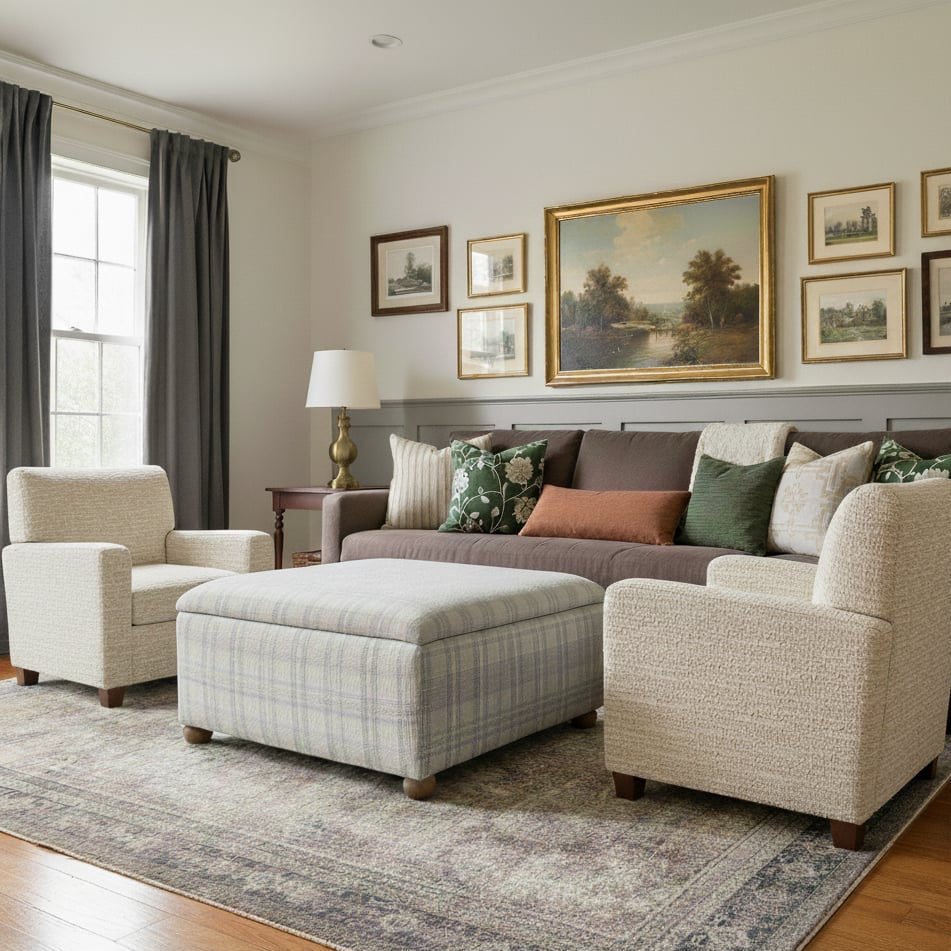
If your seating is two chairs and a small sofa instead of one large sofa, an ottoman placed between the chairs works beautifully — it bridges the seating and creates a third surface for trays, drinks, or feet. In this layout, the ottoman should be roughly the same width as the chair seats and ideally about the same height. It should feel like it belongs to the chairs.
If you have a window seat or a bay window with no good place for a chair, a small ottoman or footstool tucked in front of it gives the space a quiet purpose. This is one of my favorite uses for a footstool — it makes a corner feel considered without filling it.
In a bedroom, a long ottoman at the foot of the bed adds storage (if you've chosen one with a lift top) and a place to sit while you're putting on shoes. The length should be most but not all of the width of the bed.
THEN THINK ABOUT PAIRING
A great ottoman doesn't try to match everything around it. The mistake I see most often is people picking an ottoman in the exact same fabric as their sofa, which makes both pieces disappear. A little contrast is what makes the room feel composed.
If your sofa is a solid linen, a tufted ottoman in a quiet check or stripe gives the room some movement without competing. If your sofa is already a pattern, a solid ottoman in one of the colors from that pattern grounds the space. If everything in your room is neutral, an ottoman in a slightly bolder color or texture — a deep oxblood velvet, a houndstooth, a moody floral — can be the moment of color that pulls the rest together.
The rule I follow: one pattern per area, max. If your sofa is patterned, your ottoman is solid. If your ottoman is patterned, your sofa is solid. The rest of the room can pick up the colors from either.
THE STYLING ON TOP
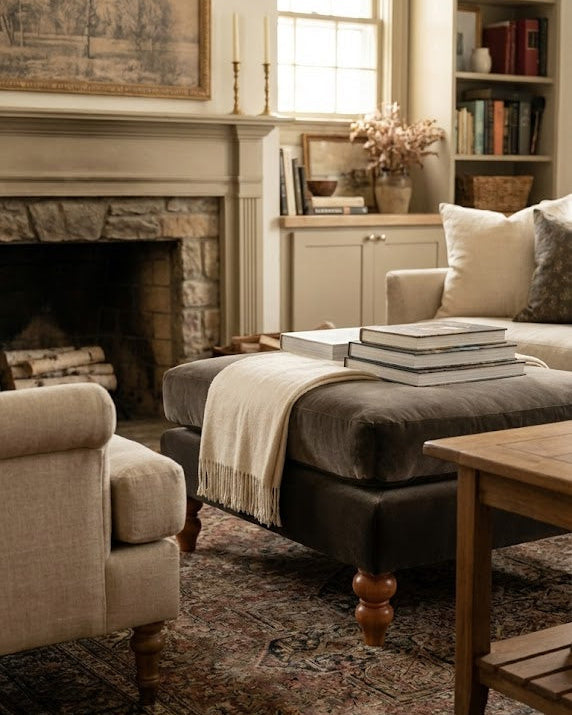
A tray on top of an ottoman is the single highest-leverage piece of styling you can do. It defines the surface, makes it usable for drinks and books, and adds a moment of contrast against the upholstery. A round tray on a square ottoman, or a square tray on a round ottoman, is a small move that quietly does a lot.
What goes on the tray? Less than you think. A stack of two or three books with a small object on top — a candle, a ceramic dish, a little vase with one stem. Maybe a coaster or two. The point isn't to fill the tray; it's to give the eye somewhere to land.
If you don't want a tray, leaving the top empty is also right. An ottoman in a beautiful fabric doesn't need anything on it to do its work.
A FEW QUIET RULES
A few principles I come back to when I'm helping someone style their living room:
Pair soft with structured. A pillow-top ottoman softens a room with a lot of straight lines. A firm tufted ottoman adds structure to a room of slouchy chairs. Look at what your room is already doing, and pick an ottoman that adds the thing it's missing.
Vintage in modern, modern in vintage. A vintage footstool with wood legs in an otherwise modern room gives the modern room a soul. A clean-lined modern ottoman in an otherwise vintage room keeps it from feeling like a museum.
Color is allowed to disagree. The most beautiful rooms I've ever seen had at least one piece of furniture that was a slightly unexpected color — a marigold ottoman in an otherwise neutral room, a deep emerald in a room of warm browns. The trick is to repeat the color somewhere small (a pillow, a vase) so it feels intentional.
Lower is more relaxed; higher is more formal. A low-slung pillow-top ottoman makes a room feel casual and lived-in. A taller, more structured ottoman makes a room feel composed. Neither is better — choose the one that matches the way you actually live.
ONE LAST THING
Styling a living room well is mostly about restraint. The instinct is to keep adding things; the better instinct is to take one thing away. An ottoman at the right scale, in the right fabric, with one tray on top — that's almost always more than enough.