Article: How to Choose an Ottoman (Without Overthinking It)
How to Choose an Ottoman (Without Overthinking It)
Most of the questions I get from people thinking about an ottoman aren't actually about ottomans. They're about whether the one they're considering is the right size, the right shape, or the right style for the room they have in mind. Those are the questions that matter most. The wrong ottoman in a great room looks worse than no ottoman at all.
Here's how I'd think it through if I were the one buying...
START WITH WHAT YOU WANT IT TO DO
This sounds obvious, but it's the part most people skip. An ottoman can do three different jobs, and the right shape depends on which one you're hiring it for.
If you want a footrest — somewhere to actually put your feet up at the end of a long day — you need something soft, plush enough to be comfortable, and the right height for your sofa or chair. A pillow top or a cushioned top is right for this.
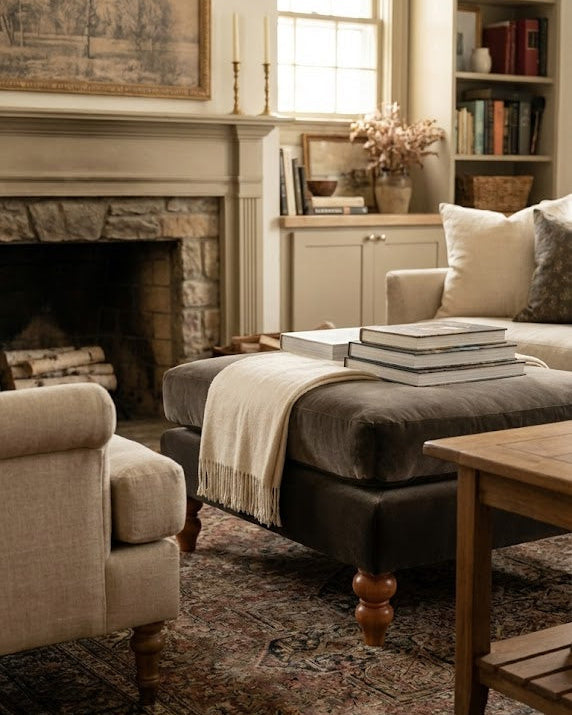
If you want a coffee table replacement — a place to set a tray, a book, a glass of wine — you need something firmer, flatter on top, and ideally with a tray you can use when you don't want to set a glass directly on fabric. A tufted top works well here because the buttons keep the surface flat enough to hold things.
If you want both, that's fine too — most ottomans can do both jobs reasonably well, but you'll pick a slightly different shape depending on which job matters more to you. A softer top is more comfortable but harder to set things on. A firmer top is the opposite.
THEN THINK ABOUT SIZE
Sizing is where people get tripped up most often, and the rules are simpler than you'd expect.
Height: the top of the ottoman should be roughly the same height as the seat cushion of your sofa, or about an inch lower. Although this rule should be adapted if your couch is very lofty and the seat goes down a good amount when seated - in that case measure the height of the seat when you are seated. Higher than the seat looks awkward. Much lower stops being comfortable as a footrest.
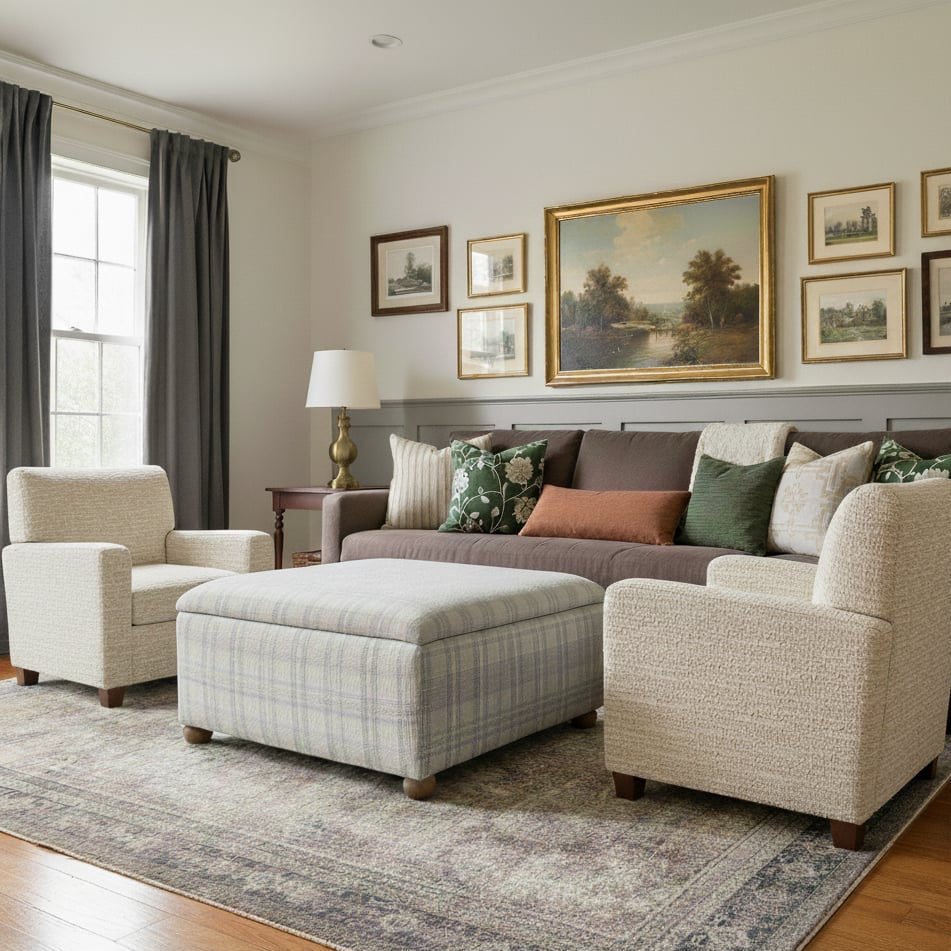
Length and depth: if you're putting it in front of a sofa, the ottoman should be no longer than about two-thirds the length of the sofa, with enough room around it (at least 14–18 inches) for someone to walk past comfortably. Bigger is not better. A too-large ottoman makes a living room feel cramped.
If you're using it between two chairs, you want it about the same width as the chair seats and not too tall — it should feel like it belongs to the chairs, not compete with them.
STYLE IS THE PART MOST PEOPLE OVERTHINK
Here's the honest truth: most ottomans work with most rooms, as long as the proportion is right. A simple skirted ottoman in a neutral linen will look at home in almost any living room. A tufted velvet ottoman will look at home in most living rooms that already have a little formality going. A vintage footstool with wood legs will look at home in a room with traditional furniture, or in a room that could use a little vintage character.
What clashes is mismatched formality. A very formal tufted ottoman in a casual beachy room will feel awkward. A casual woven pouf in a formal drawing room will too. Pick something that's in the same key as your other furniture and it'll work.
If you're not sure where the line is, lean toward simpler. A clean silhouette in a quiet color is rarely wrong. Bold patterns and unusual shapes can be wonderful, but they have to be the right call for the room.
If you're looking for guidance during this stage of the process - I do offer fabric consultations for customers who are interested following their purchase.
ONE LAST THING
When you're choosing an ottoman, the temptation is to over-research and over-think it. Don't. Read the basics, pay attention to size and quality, and then pick the one you actually like looking at. Almost every "wrong" ottoman I've seen in a room was the result of someone choosing for resale, or for trends, or for what they thought they should want. The ottoman you love living with is the right one. The rest is detail.